
BIS Extends Implementation Deadline for Revised LED Luminaire Standards (IS 10322 Series) to February 2027
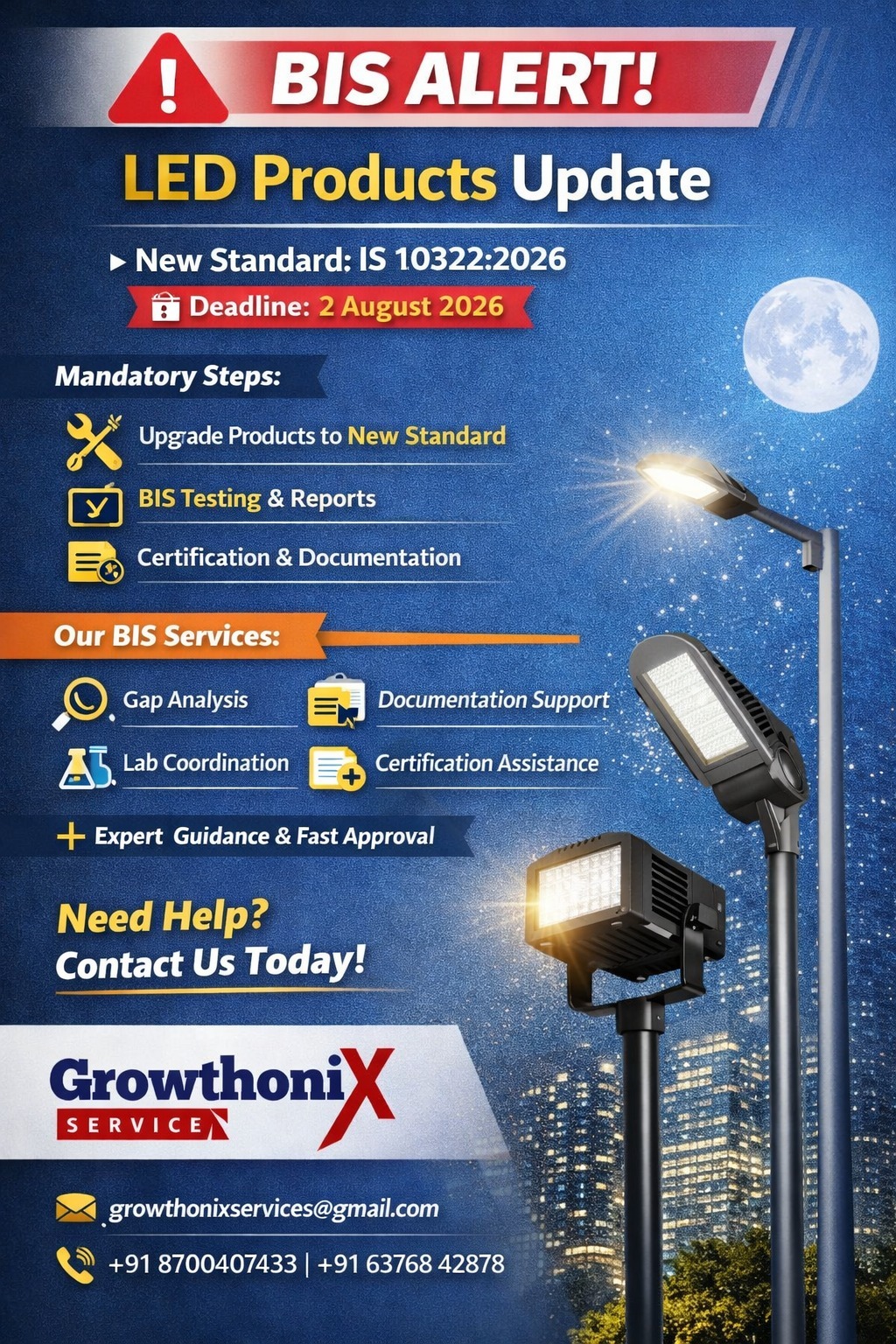
The Bureau of Indian Standards (BIS) has announced an important extension for the implementation of revised standards applicable to various LED luminaire products. According to the BIS circular issued on 31 July 2026, the deadline for the concurrent running of existing and revised standards under the IS 10322 Series has been extended to 02 February 2027. This regulatory update is particularly important for manufacturers, importers, OEMs, and businesses involved in the production and sale of LED lighting products in India. The extension provides additional time to complete testing, update technical documentation, modify products where required, and ensure continued BIS compliance. When BIS introduces a revised Indian Standard, businesses may receive a transition period during which the existing standard and the revised standard can operate concurrently. This allows manufacturers and importers to prepare their products for the new requirements without an immediate disruption to production or market supply. Under the extended timeline, businesses can continue working with their existing approvals while preparing for compliance with the revised 2026 versions of the IS 10322 Series. However, after 02 February 2027, the revised standards will become the applicable requirements for the affected product categories. Therefore, manufacturers should not treat the extension as a reason to delay compliance preparation. Instead, it should be used as an opportunity to complete testing and certification activities well before the final deadline. The extension applies to seven major categories of LED luminaires covered under the revised IS 10322 Series. Fixed general-purpose LED luminaires, including certain fancy lighting products, were previously covered under IS 10322 (Part 5/Sec 1):2012. The revised standard is IS 10322 (Part 5/Sec 1):2026, aligned with IEC 60598-2-1:2020. Recessed LED luminaires were previously covered under IS 10322 (Part 5/Sec 2):2012. The revised requirement is IS 10322 (Part 5/Sec 2):2026, aligned with IEC 60598-2-2:2023. Road and street lighting products were previously governed by IS 10322 (Part 5/Sec 3):2012. The revised standard is IS 10322 (Part 5/Sec 3):2026, aligned with IEC 60598-2-3. LED flood lights covered under IS 10322 (Part 5/Sec 5):2013 will transition to IS 10322 (Part 5/Sec 5):2026, aligned with IEC 60598-2-5:2015. LED hand lamps currently covered under IS 10322 (Part 5/Sec 6):2013 will transition to IS 10322 (Part 5/Sec 6):2026, aligned with IEC 60598-2-8:2013. LED lighting chains currently covered under IS 10322 (Part 5/Sec 7):2017 will transition to IS 10322 (Part 5/Sec 7):2026, aligned with IEC 60598-2-20:2022. Emergency lighting luminaires currently covered under IS 10322 (Part 5/Sec 8):2013 will transition to IS 10322 (Part 5/Sec 8):2026, aligned with IEC 60598-2-22:2022. For all seven categories, the revised date for concurrent running is 02 February 2027. Other terms and conditions specified in the earlier BIS circular dated 20 March 2026 remain applicable unless otherwise modified. Businesses should begin by conducting a detailed review of their existing LED product portfolio. Manufacturers should identify which models are currently covered under the older IS 10322 standards and determine whether additional testing or technical modifications are required under the revised standards. The next important step is laboratory testing. Companies should plan testing well in advance because testing laboratories may experience increased demand as the February 2027 deadline approaches. Early testing can help businesses avoid unnecessary delays in certification and product launches. Manufacturers should also review important components such as LED drivers, electrical circuits, insulation systems, thermal management arrangements, enclosures, wiring, and mechanical construction. Products should be evaluated against the applicable revised requirements before submitting samples for testing. Importers and OEMs should coordinate closely with their overseas manufacturers and suppliers. Product specifications, technical documentation, test reports, and manufacturing configurations may need to be reviewed to ensure that imported products meet the revised Indian requirements. BIS compliance is essential for businesses manufacturing or importing products covered by applicable Indian standards and regulatory requirements. Failure to transition to the revised requirements within the applicable timeline can create certification, manufacturing, import, and market-access challenges. The extension until 02 February 2027 gives businesses additional preparation time, but companies should begin the transition process early. Completing product assessment, testing, documentation, and BIS certification updates before the deadline can help ensure uninterrupted business operations. The BIS extension for the revised IS 10322 Series:2026 is a significant compliance update for the Indian LED lighting industry. Manufacturers, importers, and OEMs now have additional time to prepare their products for the revised requirements applicable to fixed luminaires, recessed luminaires, street lighting, flood lights, hand lamps, lighting chains, and emergency lighting products. Businesses should use this extended transition period strategically by reviewing their existing certifications, arranging laboratory testing, updating technical documentation, and completing necessary BIS certification activities. Preparing early can help reduce compliance risks and support smooth transition to the revised standards before 02 February 2027.What Is the Concurrent Running Period?
LED Luminaire Categories Covered Under the Extension
1. Fixed General Purpose LED Luminaires
2. Recessed LED Luminaires
3. LED Luminaires for Road and Street Lighting
4. LED Flood Lights
5. LED Hand Lamps
6. LED Lighting Chains
7. LED Luminaires for Emergency Lighting
What Should Manufacturers and Importers Do?
Importance of BIS Compliance
Conclusion