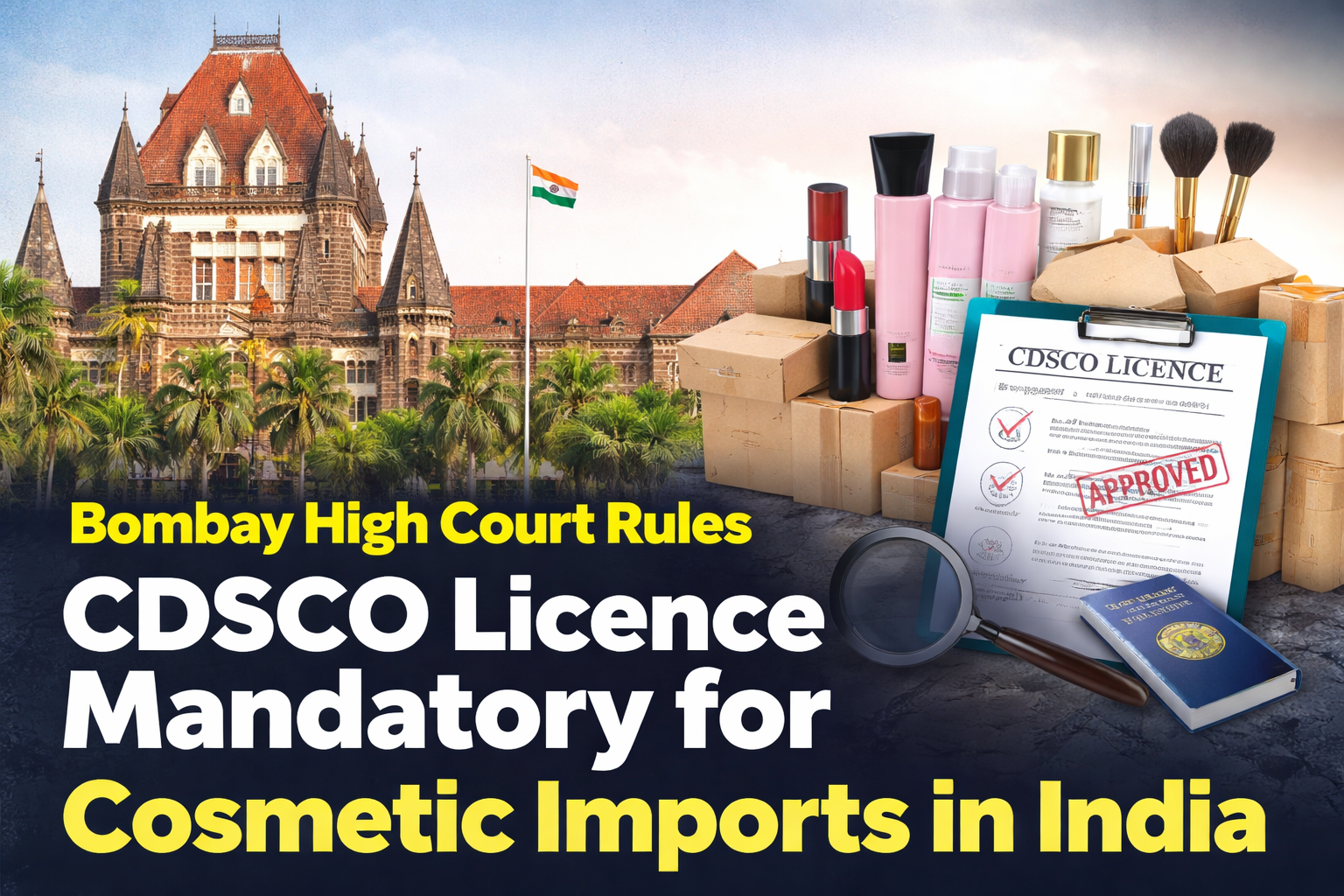
Bombay High Court Makes CDSCO Licence Mandatory for Cosmetic Imports in India
In a significant judgment impacting the cosmetics and import-export industry, the Bombay High Court has ruled that obtaining a licence from the Central Drugs Standard Control Organisation (CDSCO) is mandatory for importing cosmetics into India—even if the goods are intended only for warehousing or re-export. This ruling reinforces strict regulatory compliance under Indian law and sends a strong message to importers and traders dealing in cosmetic products.
Background of the Case
The case arose when a company, Glamstone Cosmetics Pvt. Ltd., imported cosmetic consignments from the UAE and stored them in bonded warehouses in India. The importer claimed that the goods were not meant for sale in the domestic market but were intended for re-export to other countries. Based on this argument, the company contended that CDSCO registration was not required.
However, the Directorate of Revenue Intelligence (DRI) seized the consignments, alleging violations of regulatory provisions and undervaluation. The importer approached the Bombay High Court seeking permission to re-export the goods and quash the seizure.
Court’s Key Observation
The Bombay High Court rejected the importer’s argument and held that any cosmetic product entering India must comply with CDSCO regulations at the time of import itself. The Court emphasized that simply declaring goods for warehousing or re-export does not exempt importers from statutory requirements.
The bench clarified that once goods physically enter Indian territory, it qualifies as “import” under the law. Therefore, all applicable rules under the Drugs and Cosmetics Act, 1940, and Cosmetics Rules, 2020 must be followed.
Cosmetics Without CDSCO Licence Considered “Prohibited Goods”
One of the most important aspects of the judgment is the classification of non-compliant imports. The Court held that cosmetics imported without CDSCO registration can be treated as “prohibited goods” under the Customs Act, 1962.
This classification has serious consequences. Prohibited goods can be seized, confiscated, and subjected to legal proceedings. The Court further noted that allowing such goods to be re-export without completing investigations would weaken enforcement of regulatory laws.
Warehousing Does Not Bypass Compliance
The petitioner argued that India’s warehousing provisions allow goods to be stored without fulfilling all regulatory conditions, especially if they are not intended for domestic sale. However, the Court firmly rejected this interpretation.
According to the judgment, the warehousing mechanism under customs law is meant to defer payment of duties, not to bypass other legal requirements. The Court stated that regulatory compliance under the Drugs and Cosmetics Act applies regardless of whether the goods are meant for sale or re-export.
This interpretation ensures that India does not become a transit hub for unregulated or potentially unsafe cosmetic products.
Legal Framework Considered
The Court examined multiple laws together, including:
-
Customs Act, 1962
-
Drugs and Cosmetics Act, 1940
-
Cosmetics Rules, 2020
It highlighted that the definition of “prohibited goods” under the Customs Act includes goods restricted under any other law. Therefore, failure to comply with CDSCO requirements automatically attracts action under customs law as well.
Impact on Importers and Businesses
This ruling has far-reaching implications for businesses involved in cosmetic imports, logistics, and international trade:
-
Mandatory Compliance: Importers must obtain CDSCO registration before bringing cosmetics into India, irrespective of their intended use.
-
No Exception for Re-export: Even temporary imports for warehousing or re-export require full regulatory approval.
-
Increased Scrutiny: Authorities are likely to increase checks on cosmetic imports to ensure compliance.
-
Risk of Seizure: Non-compliant goods may be seized, confiscated, or subjected to penalties.
Industry Implications
The judgment is expected to impact not only importers but also logistics providers, warehouse operators, and international traders who use India as a transit point. Companies will now need to review their import strategies and ensure proper documentation before shipping goods into India.
Additionally, this ruling strengthens India’s regulatory framework for cosmetics, ensuring that only approved and safe products enter the country.
Conclusion
The Bombay High Court’s decision makes it clear that CDSCO licence is not optional but mandatory for all cosmetic imports into India. The ruling eliminates any ambiguity regarding warehousing and re-export exemptions and reinforces the importance of strict compliance with Indian laws.
For businesses, this serves as a critical reminder to align their import practices with regulatory requirements. Failure to do so can result in severe legal consequences, including seizure and confiscation of goods.
In conclusion, the judgment promotes transparency, consumer safety, and regulatory discipline in India’s cosmetics import sector, making compliance a non-negotiable aspect of international trade.